
TSP ECG #3
Male, 54 y/o

Comment on rate, rhythm, axis and anything abnormal you can find.
This quiz is a learning tool and is designed to promote discussion, so if you disagree with our analysis, sound off in the comments below; we’re learning, too!

TSP ECG #3
Male, 54 y/o
Comment on rate, rhythm, axis and anything abnormal you can find.
This quiz is a learning tool and is designed to promote discussion, so if you disagree with our analysis, sound off in the comments below; we’re learning, too!
During the festive season, its easy to indulge in excess; too many sprouts, an increase in afternoon napping, festive drinks… You know the score. It isn’t all smiles and sunshine, though, as we shall see.
One particular result of all the festive excess relevant to cardiac professionals, has been reported across the globe, but particularly in Entirely Fictitious Primary Care Centres (EFPCCs); Bacardi Branch Blocks, or BacBBs
BacBBs are thought to affect the heart as a whole, but it can be seen that they have a particularly odd effect on the ventricles, and cause an odd, never-seen-in-real-life depolarisation wave on the ECG, that actually defies physics and medical science by going back in time!
Symptom sheets compared with the compiled ambulatory data have shown unanimously that BacBBs are present sporadically within sinus rhythms, but coincide with that one-drink-too-many during a family game of Monopoly (Mr Moneybags isn’t thought to be an underlying cause, so the activity isn’t seen as a risk factor).
Atrial activity stops altogether, presumably because the SA node just forgets what it’s doing, as it’s seen enough crepe paper hats and screwdriver sets fly from crackers to last it a lifetime.
After an episode of BacBB, sinus rhythm resumes, and the patient will return to whatever their festive-norm may be until the next instance.
This phenomenon seems to disappear entirely during the first couple of weeks of January, when normal working hours begin again, hence, I feel that it is triggered by the holidays themselves.
None of this is being researched, or is even disputed, because it is both totally false, and invented entirely by me.

Bacardi Branch Block
TSP ECG #2
Male, 76y/o

Comment on rate, rhythm, axis and anything abnormal you can find.
This quiz is a learning tool and is designed to promote discussion, so if you disagree with our analysis, sound off in the comments below; we’re learning, too!

Remember those anatomy and physiology lectures that tortured you? Remember all that terminology that was relentlessly thrown at you for hours every week? Remember the pop-quizzes? Remember wishing there was an easier way to store all the information you were given?
Of course you do.
A few institutions have employed a rather novel way of encouraging learning by doing, by combining art and anatomical learning. Cathal Breen of Analyse fame kindly sent me a copy of the University of Ulster’s journal outlining a study he was a part of, that brought the two disciplines together.
The study focuses on exactly what I outlined in the first paragraph: the difficulty in learning anatomical names and information via textbooks and lectures alone. Students from radiology and cardiac physiology formed groups and learned by painting anatomical structures on each other, using textbooks, presentations and spoken word.


By encouraging students and staff to engage in the teaching and learning process in this creative manner yielded incredibly positive results: student feedback referred to the sessions as “enjoyable”, “helpful” and “interesting”, citing the experience as one that makes things clearer, too. The study humorously points out that the first three statements are not things that have been used to describe A&P before (thanks to my own experience, I imagine this to be an indisputable fact).
Obviously, there may be issues with inhibition when it comes to each individual, so to get around this, painting onto clothing; t shirts, gloves etc, is an option. Lecturer participation is a must, so the whole thing seems to lend itself to full participation from everyone and bonding in a shared learning experience.
Students pointed out that this style of learning made them aware of discrepancies between actual anatomy and the pictures contained within the textbooks they used, and that gave them a better understanding of the internal geography present in the body. In recent years, the practice has been adopted by numerous institutions, and the twitter page @artandanatomy showcases some of the wonderful body-painted works of art that have cropped up across the globe.
So, what do you think? Would this be something you feel would make the learning process easier for you? Sound off in the comments below and let us know.
Ref:
Breen, C., Conway, S., Fleming, K.,. (2010) The Art of Teaching Anatomy – A Case Study. Perspectives on Pedagogy and Practice 1 (1), pp. 17-30.
Images courtesy of @artandanatomy

I never considered just how difficult trace analysis could be. Don’t get me wrong; I knew it would be hard, I just didn’t fully appreciate quite how hard.
During lectures on specific arrhythmias, when ECGs are displayed, they generally contain the abnormalities that make up the subject matter so it doesn’t take long to come to the correct answer, but looking at a trace without any history or prompting as to the condition, is still overwhelming to me. So overwhelming, in fact, that I often feel like I’m falling short of the mark with regards to my learning as a whole. The TSP ECG section is as much for my benefit as it is for you guys, in that I’ve found analysing the ones selected for posting incredibly difficult.
No matter what answer I come to, there’s always the lingering worry that I’ve missed something.
How much is too much, with regards to analysing?
What’s a result of over-analyzing, and what’s accurate?
Textbook traces, whether clinical, or stylised, have been selected as the best possible example of the rhythms under scrutiny, so it stands to reason that they won’t exactly mimic those that will be encounered in the field. In my limited experience, clinical traces contain a great deal of variation and have thus far, rarely resembled anything you’d find in a book.
They have been difficult, yes, but they have also been possible. This will all become easier, with practice (I assume/hope), so I hope you all find the analysis quiz good practice, as it’s certainly proving to be that for me.
TSP ECG #1
Male, 80 y/o.

Comment on the rate, rhythm, axis and anything abnormal you can find.
This quiz is a learning tool and is designed to promote discussion, so if you disagree with our analysis, sound off in the comments below; we’re learning, too!

My last article looked at the assessment of Left Ventricular Hypertrophy; its contextual clinical significance and subsequent electrocardiographic findings, and concluded with possible pathological reasons for the development of LVH of which I wanted to discuss in my next article.
Sadly, due to an onslaught of assignments more intimidating than Xerxes Persian army in the film 300, I haven’t had the time to write any subsequent material.
However, now the assignments are over I have the time to explore these pathological causes of LVH.
Just as a recap, LVH is an increase in the size and proportion of the left ventricular myocardium. Just like any muscle, the more it is permitted to carry out work (contract) the greater it will increase in size (hypertrophy).
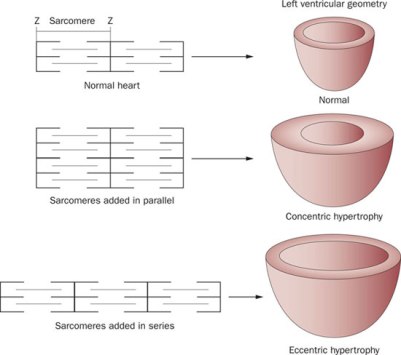
This increase in muscular size results from increased recruitment of sarcomeres (basic subunit of muscle cells) as well as extra cellular matrix remodeling (the scaffolding material of tissue). As a result of these anatomical adaptations the ventricle changes in size and proportion. Its normal conoid shape may be altered.
Concentric/Eccentric Hypertrophy
This remodeling will present as either Concentric or Eccentric hypertrophy depending on the underlying cause.
Concentric hypertrophy results from chronic pressure overload commonly associated with chronic hypertension and aortic stenosis. New sarcomeres are added in parallel to existing sarcomeres. Wall thickness greatly increases and persistence over time will significantly reduce chamber radius. The remodeled ventricle has reduced contractility and compliance leading to diastolic and eventually systolic dysfunction (impaired filling/ejection).
Eccentric hypertrophy often occurs with volume and pressure overload; pathological associations include heart failure; aortic/mitral regurgitation (volume overload) and chronic hypertension (pressure overload). Ventricular remodeling results in increased chamber radius and moderate increases in wall thickness. Chamber dilation occurs as new sarcomeres are added in series to existing sarcomeres.
Physiological consequences of LVH
LVH usually develops as a compensatory response to the underlying pathologies mentioned above. Increased arterial pressure (afterload) as a result of chronic hypertension and/or aortic stenosis increases the pressure required of the LV to eject this blood. Increased LV wall tension compensates via concentric hypertrophy.
Volume overload within the heart (heart failure) is often a resultant of valvular regurgitation and/or systolic dysfunction. Aortic/mitral regurgitation will increase the volume of blood left in the ventricle after systole (End Systolic Volume). During the next systolic cycle the LV has to contract with greater force to eject this increased volume of blood (End Diastolic Volume). Frank Starlings law of the heart states that increased stretch on the myocardial wall (Preload) increases strength of contraction. This pressure/volume overload induces chamber dilation and eccentric hypertrophy.
The hypertrophied LV becomes less compliant reducing its filling and contractile capacities. This culminates in systolic dysfunction. Systolic dysfunction is a significant reduction in cardiac output and will present with symptoms of dizziness, fatigue and shortness of breath. Systolic dysfunction of the LV will also lead to pulmonary congestion due to the back up of pressure generated by increased atrial and pulmonary venous pressures resulting from the increased EDV.
LVH is one of the strongest predictors of cardiac morbidity in hypertensive patients. The degree of hypertrophy correlates with the development of congestive heart failure, angina, arrhythmia, myocardial infarction and cardiac death (Lilly).
Another pathological subcategory I have not eluded to that is also a major contributor to LVH is cardiomyopathies. This is something I will look at in detail in my next article. Thanks for reading 🙂
I’d just like to take the opportunity to thank my good friend and partner in crime Christopher Wild for firstly creating this fantastic physiology based resource and secondly giving me the opportunity to participate in its progression.
3 months since creation and the TSP has already received nearly 1500 hits, recognition and support from numerous universities and academics across the country as well as our professional governing body.
My buddy deserves massive acclamation for this achievement and I know there is much more to come!
Whilst writing this article it has again reminded me how interconnected many pathologies, symptoms and clinical findings can be. About half way through writing I felt as though I’d opened a big can of worms as there are so many different tangents on which you could proceed to discuss. Added to this is the limited knowledge I have as I’m only a second year student! Therefore please don’t take this information as cardiology gospel! I have and always will, use reliable sources of information, but this is my interpretation of such material and I can’t guarantee inclusion of every detail. Nevertheless, I have personally found writing such articles to be of great benefit; and thus if there are any other physiology students out there that may be interested in writing for TSP we would greatly welcome your support.
Ref:
http://www.cvphysiology.com/Heart%20Failure/HF009.htm
Image from:
One of the SCST Annual Update sections most relevant to PTP students was based around postgraduate preceptorship. Delivered by Sophie Blackman, of Boston Scientific and the SCST, the talk went through the updates regarding the assessment and accreditation that a newly qualified physiologist can obtain, in conjunction with the council. Sophie stated that she has been quite heavily involved in the production of this framework, and proceeded to outline its intricacies.
The preceptorship programme is relevant to PTP students, because it is aimed specifically at us once we are “let loose”, as it were, into clinical practice. The SCST has received a great deal of feedback from around the country, pertaining to the varying levels at which new healthcare scientists are emerging from their academic study and also feedback from students themselves, on what they feel they need by way of support from the governing body. I for one, can appreciate this; I’m terrified of graduating. I’m confident in my own skills, thus far, and whilst I don’t think that fear will ever go away, I think it’s beneficial for newly qualified HCS to have someone outside of their department that can help them make that transition from student to professional. This nationwide initiative will help to provide this support for the individual, but will also ensure there is an equitable workforce in practice.
The programme itself is based around the individual, and is likely to take anywhere from six months, to two years, based on proficiency. Much like in your current degrees (if you’re a student), the programme features competencies and case based discussions, but in this case, they are undertaken as you perform a job at which you are already doing. Upon “qualification” (this may seem like an odd word to use, given the fact that the practitioner is already qualified, but bear with me…), the student will receive a certificate displaying their confidence in a particular discipline, and that can not only demonstrate a willingness on the practitioner’s part to be the best that they can be, but it will further cement that person’s knowledge and skills base to aid them in their position, thereby helping them, to a point, to leave the student role behind them.
The implication was that if you, as a new HSP, want to make that leap to the STP programme, or follow a different career framework, then this accreditation will assist in identifying your individual fortes, and allow you to perhaps see what pathway you would be best suited to.
The full texts relevant to students are given below:
Preceptorship guidance for HSPs
For more information, visit the SCST preceptorship page:

If you visit this site regularly, or follow the TSP twitter, you’ll hopefully be aware that I try to post updates and tweet fairly regularly. Sometimes they are in the form of personal pieces such as this, sometimes they are reviews or study guides, sometimes minor news updates or small tweaks to the site itself.
If you’ve visited this site recently, however, you might have noticed that I haven’t updated it for a little while. There’s one reason for this, and one reason alone: the assignment.
I’m seeing the light at the end of the tunnel as I type this, due to the fact that my extended case study is now submitted. It was a great piece of work to take on, too. Three sections in total, each with its own word count. The first was a patient case study, with a provided patient history, two electrocardiography traces to analyse and compare, and the subsequent report and treatment pathway to complete. This was probably the most fun of the three, but also the most time consuming.
The second was a broad topic that had to be condensed into a relatively small word count. This was, without question, the most difficult of the three sections and whilst I’m confident in the content I submitted, it’ll be interesting to read my feedback and see how well I interpreted the question.
The third, a brief similar to the second section only with a much more specific topic was initially fairly free-flowing, in terms of writing, but the further I progressed through it, the further away that word count looked. What began as a torrent of information on the page, soon trickled to a halt, as I realised I had explored all of the avenues in my plan without leaving room for branching out. As a result, I had to go back through every paragraph and find some wiggle room to potentially add another facet to the discussion.
I’m being intentionally vague so as not to disclose any details of the assignment, rather I’m confirming what we all know about assignments; there are some we like, and there are some that we loathe.
If you’re currently in the midst of a large piece of work, don’t panic! Just power through. Don’t worry about your friends posting Facebook updates from the pub, don’t worry about your Christmas shopping just yet. I know it’s easier said than done, of course, but despite the fact that (technology permitting) this article has gone live at around 3pm, as I type this, it’s 4.30am. Pressing that ‘submit’ button on my coursework has sent me into a state of fatigued euphoria, and all the late nights have been worth it.
I’ll add that on top of this assignment, I also have deadlines for an Inter-professional Collaboration self-reflective essay and a presentation on cardiac technology in the same week. Next week.
Until then, it’ll be a bit quieter around here…



 The Student Physiologist