Pathological causes of LVH

My last article looked at the assessment of Left Ventricular Hypertrophy; its contextual clinical significance and subsequent electrocardiographic findings, and concluded with possible pathological reasons for the development of LVH of which I wanted to discuss in my next article.

Sadly, due to an onslaught of assignments more intimidating than Xerxes Persian army in the film 300, I haven’t had the time to write any subsequent material.

However, now the assignments are over I have the time to explore these pathological causes of LVH.

Just as a recap, LVH is an increase in the size and proportion of the left ventricular myocardium. Just like any muscle, the more it is permitted to carry out work (contract) the greater it will increase in size (hypertrophy).

This increase in muscular size results from increased recruitment of sarcomeres (basic subunit of muscle cells) as well as extra cellular matrix remodeling (the scaffolding material of tissue). As a result of these anatomical adaptations the ventricle changes in size and proportion. Its normal conoid shape may be altered.

Concentric/Eccentric Hypertrophy

This remodeling will present as either Concentric or Eccentric hypertrophy depending on the underlying cause.

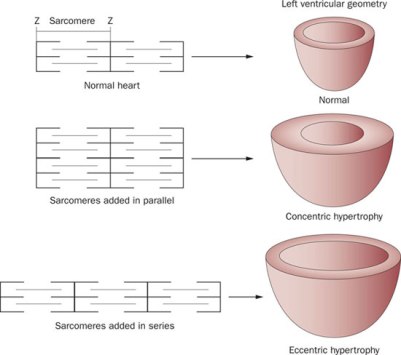
Concentric hypertrophy results from chronic pressure overload commonly associated with chronic hypertension and aortic stenosis. New sarcomeres are added in parallel to existing sarcomeres. Wall thickness greatly increases and persistence over time will significantly reduce chamber radius. The remodeled ventricle has reduced contractility  and compliance leading to diastolic and eventually systolic dysfunction (impaired filling/ejection).

Eccentric hypertrophy often occurs with volume and pressure overload; pathological associations include heart failure; aortic/mitral regurgitation (volume overload) and chronic hypertension (pressure overload). Ventricular remodeling results in increased chamber radius and moderate increases in wall thickness. Chamber dilation occurs as new sarcomeres are added in series to existing sarcomeres.


Figure-4-Concentric-and-eccentric-hypertrophy-can-be-distinguished-by-the-orientation-in

Physiological consequences of LVH

LVH usually develops as a compensatory response to the underlying pathologies mentioned above. Increased arterial pressure (afterload) as a result of chronic hypertension and/or aortic stenosis increases the pressure required of the LV to eject this blood.  Increased LV wall tension compensates via concentric hypertrophy.

Volume overload within the heart (heart failure) is often a resultant of valvular regurgitation and/or systolic dysfunction. Aortic/mitral regurgitation will increase the volume of blood left in the ventricle after systole (End Systolic Volume). During the next systolic cycle the LV has to contract with greater force to eject this increased volume of blood (End Diastolic Volume). Frank Starlings law of the heart states that increased stretch on the myocardial wall (Preload) increases strength of contraction. This pressure/volume overload induces chamber dilation and eccentric hypertrophy.

The hypertrophied LV becomes less compliant reducing its filling and contractile capacities. This culminates in systolic dysfunction. Systolic dysfunction is a significant reduction in cardiac output and will present with symptoms of dizziness, fatigue and shortness of breath. Systolic dysfunction of the LV will also lead to pulmonary congestion due to the back up of pressure generated by increased atrial and pulmonary venous pressures resulting from the increased EDV.

LVH is one of the strongest predictors of cardiac morbidity in hypertensive patients. The degree of hypertrophy correlates with the development of congestive heart failure, angina, arrhythmia, myocardial infarction and cardiac death (Lilly).

Another pathological subcategory I have not eluded to that is also a major contributor to LVH is cardiomyopathies. This is something I will look at in detail in my next article. Thanks for reading 🙂


I’d just like to take the opportunity to thank my good friend and partner in crime Christopher Wild for firstly creating this fantastic physiology based resource and secondly giving me the opportunity to participate in its progression.

3 months since creation and the TSP has already received nearly 1500 hits, recognition and support from numerous universities and academics across the country as well as our professional governing body.

My buddy deserves massive acclamation for this achievement and I know there is much more to come!

Whilst writing this article it has again reminded me how interconnected many pathologies, symptoms and clinical findings can be. About half way through writing I felt as though I’d opened a big can of worms as there are so many different tangents on which you could proceed to discuss. Added to this is the limited knowledge I have as I’m only a second year student! Therefore please don’t take this information as cardiology gospel! I have and always will, use reliable sources of information, but this is my interpretation of such material and I can’t guarantee inclusion of every detail.  Nevertheless, I have personally found writing such articles to be of great benefit; and thus if there are any other physiology students out there that may be interested in writing for TSP we would greatly welcome your support.

Screenshot (39)

Ref:

Lilly, L. S. (ed.) (2010) Pathophysiology of heart disease: A collaborative project of medical students and faculty. Editor, Leonard S. Lilly. 5th edn. Philadelphia, PA: Lippincott Williams and Wilkins.
(Lilly, 2010, pp. 315 – 315)

http://www.cvphysiology.com/Heart%20Failure/HF009.htm

Image from:

https://www.researchgate.net/figure/51745685_fig2_Figure-4-Concentric-and-eccentric-hypertrophy-can-be-distinguished-by-the-orientation-in


Postgraduate Preceptorship

One of the SCST Annual Update sections most relevant to PTP students was based around postgraduate preceptorship. Delivered by Sophie Blackman, of Boston Scientific and the SCST, the talk went through the updates regarding the assessment and accreditation that a newly qualified physiologist can obtain, in conjunction with the council. Sophie stated that she has been quite heavily involved in the production of this framework, and proceeded to outline its intricacies.

The preceptorship programme is relevant to PTP students, because it is aimed specifically at us once we are “let loose”, as it were, into clinical practice. The SCST has received a great deal of feedback from around the country, pertaining to the varying levels at which new healthcare scientists are emerging from their academic study and also feedback from students themselves, on what they feel they need by way of support from the governing body. I for one, can appreciate this; I’m terrified of graduating. I’m confident in my own skills, thus far, and whilst I don’t think that fear will ever go away, I think it’s beneficial for newly qualified HCS to have someone outside of their department that can help them make that transition from student to professional. This nationwide initiative will help to provide this support for the individual, but will also ensure there is an equitable workforce in practice.

The programme itself is based around the individual, and is likely to take anywhere from six months, to two years, based on proficiency. Much like in your current degrees (if you’re a student), the programme features competencies and case based discussions, but in this case, they are undertaken as you perform a job at which you are already doing. Upon “qualification” (this may seem like an odd word to use, given the fact that the practitioner is already qualified, but bear with me…), the student will receive a certificate displaying their confidence in a particular discipline, and that can not only demonstrate a willingness on the practitioner’s part to be the best that they can be, but it will further cement that person’s knowledge and skills base to aid them in their position, thereby helping them, to a point, to leave the student role behind them.

The implication was that if you, as a new HSP, want to make that leap to the STP programme, or follow a different career framework, then this accreditation will assist in identifying your individual fortes, and allow you to perhaps see what pathway you would be best suited to.

The full texts relevant to students are given below:

Preceptorship Framework

Preceptorship guidance for HSPs

For more information, visit the SCST preceptorship page:

new_scst_logo

Screenshot (39)


The Assignment Rush

If you visit this site regularly, or follow the TSP twitter, you’ll hopefully be aware that I try to post updates and tweet fairly regularly. Sometimes they are in the form of personal pieces such as this, sometimes they are reviews or study guides, sometimes minor news updates or small tweaks to the site itself.

If you’ve visited this site recently, however, you might have noticed that I haven’t updated it for a little while. There’s one reason for this, and one reason alone: the assignment.

I’m seeing the light at the end of the tunnel as I type this, due to the fact that my extended case study is now submitted. It was a great piece of work to take on, too. Three sections in total, each with its own word count. The first was a patient case study, with a provided patient history, two electrocardiography traces to analyse and compare, and the subsequent report and treatment pathway to complete. This was probably the most fun of the three, but also the most time consuming.

The second was a broad topic that had to be condensed into a relatively small word count. This was, without question, the most difficult of the three sections and whilst I’m confident in the content I submitted, it’ll be interesting to read my feedback and see how well I interpreted the question.

The third, a brief similar to the second section only with a much more specific topic was initially fairly free-flowing, in terms of writing, but the further I progressed through it, the further away that word count looked. What began as a torrent of information on the page, soon trickled to a halt, as I realised I had explored all of the avenues in my plan without leaving room for branching out. As a result, I had to go back through every paragraph and find some wiggle room to potentially add another facet to the discussion.

I’m being intentionally vague so as not to disclose any details of the assignment, rather I’m confirming what we all know about assignments; there are some we like, and there are some that we loathe.

If you’re currently in the midst of a large piece of work, don’t panic! Just power through. Don’t worry about your friends posting Facebook updates from the pub, don’t worry about your Christmas shopping just yet. I know it’s easier said than done, of course, but despite the fact that (technology permitting) this article has gone live at around 3pm, as I type this, it’s 4.30am. Pressing that ‘submit’ button on my coursework has sent me into a state of fatigued euphoria, and all the late nights have been worth it.

I’ll add that on top of this assignment, I also have deadlines for an Inter-professional Collaboration self-reflective essay and a presentation on cardiac technology in the same week. Next week.

Until then, it’ll be a bit quieter around here…

Screenshot (39)

SCST National Update

Yesterday, on the 20th of November, Oli and I attended the SCST annual update meeting. It’s the first physiology conference I’ve attended that wasn’t tied to one specific trust (the last one I attended was the Royal United Hospital’s respiratory medicine conference), rather, it was applicable to and attended by cardiac scientists from across the four home nations. The day was packed with talks, networking opportunities and insight into the future of the science. Speakers hailed from a variety of professions and organisations, but all were entrenched in the science of cardiology and education.

Due to the long distance travel and Birmingham’s seemingly city-wide roadworks, Oli and I missed the introduction, but we were present for the rest of the day and we recorded and annotated everything else, so whilst I’ll provide an overview here, detailed breakdowns of everything relevant to PTP study will be supplied separately, as and when time and my coursework volume allows.

Of particular note is the information on preceptorship qualification, delivered by Sophie Blackman of SCST and Boston Scientific. I collared her after the event proper, and she kindly agreed to provide the literature pertaining to this, so as soon as it’s available, I’ll add it for you all to have a mosey over. It seems like a great opportunity for newly- qualified practitioners to become super confident in all aspects of their job, so I highly recommend that you read the contents when they’re available.

Dr Patricia Oakley of King’s College outlined the plans for a new variety of health clinic: the centre that isn’t home and isn’t a hospital, but the “place in the middle”. These will be networked, multidisciplinary centres, featuring social workers, scientists, psychiatrists, GP’s, etc, so cardiac physiologists will most likely be a necessity in their implementation. The whole session really drove home the emerging importance of this profession, but also the requirement of all of us, student and qualified, to ensure that the cardiac physiologist is recognised as being at the forefront of innovation so as not to be overlooked. It was mentioned more than once, that if we don’t put ourselves forward for emerging structures, someone else will.

Dr Oakley told of the need to reduce treatment variability by region. Her example was the treatment of amputation as a result of diabetes; Devon has, by far, the highest number of below-hip amputations when compared with the rest of the UK, due to the fact that the majority of Devonian surgeons trained under a surgeon who has a penchant for this level of removal. The advent of these networked clinics will reduce this level of variability and promote consistency across the home nations.

The president of the AHCS, Dr Brendan Cooper delivered the final talk of the day, discussing the future role of the healthcare scientist in wider healthcare and medicine, and the need for physiologist prescribing. I’ll provide  a detailed breakdown of this talk next, and shall hopefully post it in this coming week.


Screenshot (39)


Interview With A Distance Learner

The fact that this specialist degree exists primarily in universities is a relatively new event; before the shakeup by Modernising Scientific Careers, the majority of training was completed in-house with an element of distance learning thrown in to assist with the theory behind the practical concepts.

As physiological science makes the transition to a 100% university- led discipline, there remain students that are still learning the “old way”. Sarah is one of those people, and I had the pleasure of working with her this year during my rotations between respiratory medicine and cardiology. In order to get a bit of insight into exactly how the course differs between bases, she kindly agreed to be interviewed for TSP.

Hux-Ham

Hello Sarah! Could you outline the structure of your week, with regards to working in your department and studying the degree simultaneously?

I’m employed by the hospital, so have to work my set hours which are Monday – Friday 08.30-16.30. Although I’m studying, I am not employed as a student, rather, I am an Assistant Technical Officer, which basically means I help around the department doing admin, portering and some clinical work. I have certain responsibilities with regards to admin that I have to keep on top of regardless of what clinical work I need to be learning.

Monday is my main admin day, so I spend the entire day sorting through referrals, checking messages & booking appointments for certain procedures that only I book. I need to keep on top of this as some of the procedures have extremely long waiting lists, so if a patient cancels last minute I need to try my best to fill that slot. Once my admin is complete I normally help out my colleague in the office with some of her work load. If there is no porter to bring inpatients up & back for echocardiograms then it is part of my job to do this as well, which means I can’t get my necessary admin work completed.

Tuesday is the start of my clinical week, unless I have been portering the previous day. At the moment I am spending all day Tuesday in analysis, analysing 24 hour and 48 hour tapes. I am able to analyse a tape independently, but as I am still learning they all need to be checked after, just in case I’ve missed something or worded my report incorrectly.

Wednesday is a half day in the department for me as I have a collaborate session starting at 12.00 so I need to be set up in the library ready to start. After my collaborate session I catch up on any studying I need to do, such as looking over lectures that have been released for the following week, researching/ writing an assignment or revising for upcoming exams. On a Wednesday morning I will either be fitting ambulatory blood pressure monitors (supervised, as I am not confident to do them alone yet) or analysing.

Thursday mornings I am in Electrocardiography, either in the department or going down to the ward, and in the afternoon I analyse.

Friday mornings I do tape clinic which occupies the entire morning and keeps me very busy, especially if I have patients returning that have had symptoms of dizziness & I need to get the tapes checked before I can let them go. I spend Friday afternoons in analysis.

That is my current working week, but I will start going on the rota soon to sit in on exercise treadmill tests as well. Most mornings I get into work at around 07.30 so I can get some studying done before work and I try to do an hour or so in the evening as well. Most weekends I keep to myself, but if I have an assignment due or exams I will do a couple of hours each day.

That’s a hectic week. This might now be a silly question, but do you feel that this is this enough?

In terms of clinical exposure … yes! But it is very hard to keep up with the academic work load when there is very little time to fit things in. I commute for over 2 hours a day so this eats into my potential study time, but I try to keep a balance of work, study and actually having a life!

Do you feel that working in the same department as you study helps you to learn more and keep you motivated?

I feel that second year especially has helped me learn, but most of the academic work in our first year wasn’t particularly relevant to cardiology. I feel like I learnt more in the last 2 months from analysing tapes than I have in the whole 2 years that I’ve worked in the department. I definitely think it has helped to keep me motivated as I’m constantly surrounded by people that are doing the job I am training for, so I’ve got a clear goal at the end of it.

You’re one of the last sets of the distance intake. Do you think, if you had the choice, you’d still do the degree in the manner you currently are, or would you choose to be based at the university?

I’ve already done a previous degree so I’ve experienced the whole student life thing, so I’m not missing out by doing it this way. At the moment I am essentially being paid to learn, which is ideal. I wouldn’t be able to afford to do this degree if I was based at the university, as I’ve already had a student loan so I’m not entitled to another. I think I get a good amount of exposure in the clinical setting, but I just have to do some of the boring admin jobs to make up for it. At the end of my degree I will have a job and I know 100% that this is the career I want for myself. I wasn’t passionate about my previous degree subject so I lost interest and didn’t want to spend the rest of my life doing it, whereas I know from working in this department and from studying the way I am, that this is what I want to do. I don’t think I’d have that level of clarity if I was based more at the university than the hospital.

That’s fair. When we worked together during my placement, I was aware of the fact that you were much more comfortable in the clinic environment than I was (obviously), so what do you feel we at the university have by way of an advantage?

I definitely think that as I’m exposed to patients and the environment all day every day that I am more confident and comfortable than yourself, but I would say that full time students based at the university have a lot more academic knowledge. We have 1/2 hours a week of contact time with our lecturers so we need to go out and research ourselves, whereas it is clear that you guys have a lot more academic time although you miss out a lot with the lack of placement.

Thanks, Sarah!

As you can probably tell, despite the fact that Sarah and myself are in the same cohort, our academic years have a vastly different focus. As I (rightly) assumed just from working with her on the department, both routes present their pros and cons, and seeing as this is a vastly understaffed form of diagnostic science, it does, in my opinion, open the career up to a greater number of people now it will be university- led.

If you’ve got an opinion, or a question regarding anything you’ve read, sound off in the comments below.

Photo courtesy of Facebook

Screenshot (39)

I Have LVH, Should I Be Worried? Normal Variants Of An ECG

As part of our course we often perform ECG’s on one another to enhance and refine our practical ECG skills. During a practical recently I volunteered to be the patient so that my fellow students could practice their electrode placement skills; whilst being filmed and critiqued by others. The group universally agreed in the value of this experience, despite the fact it felt strange performing an ECG to an audience of your friends whilst being filmed in an artificial clinical environment. After everyone had practiced we printed of a recording of my ECG. Our lecturer, whom is a senior physiologist, explained that we would as a class analyse the ECG in our following lecture.

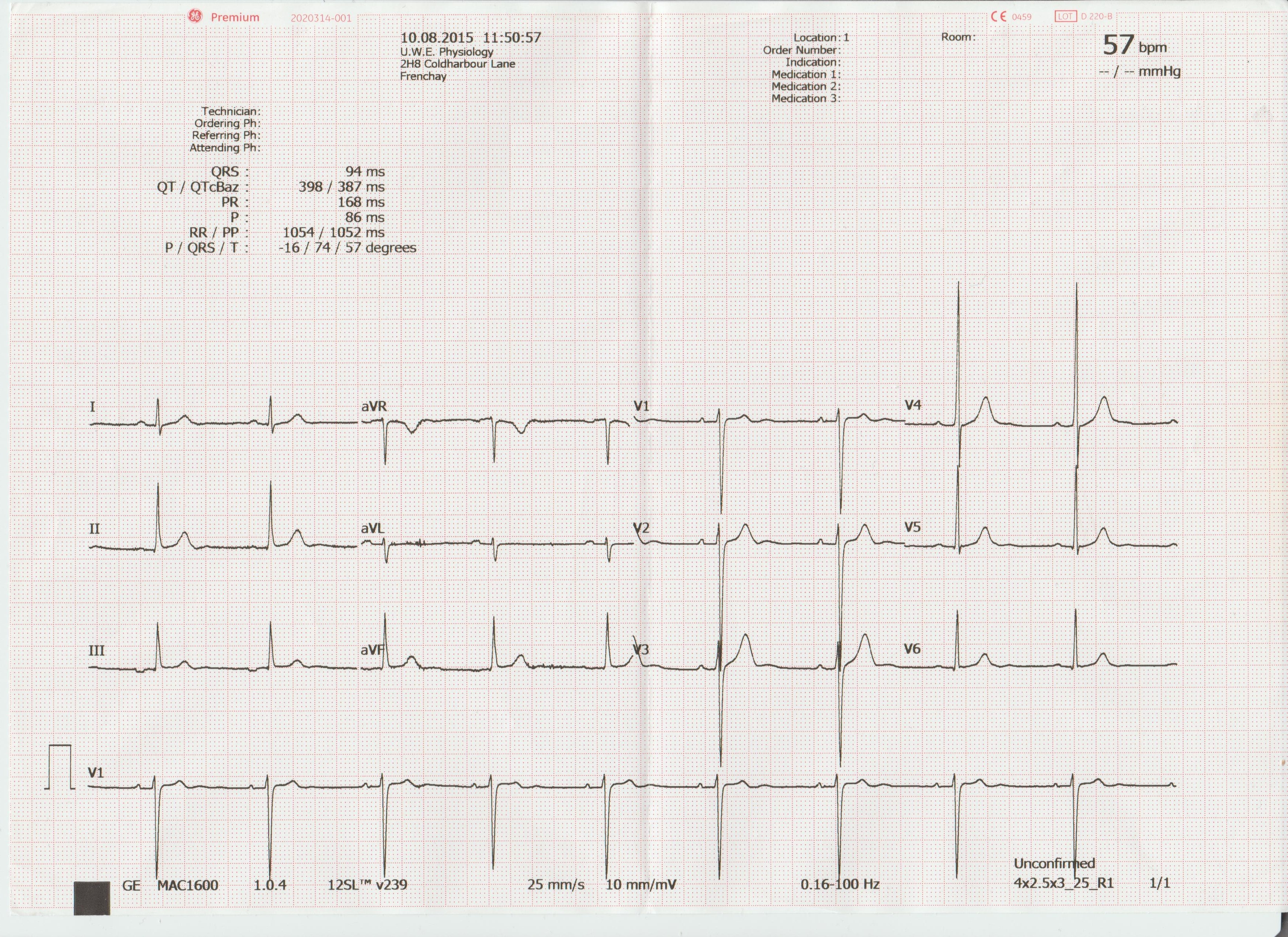
Upon the analysis of my ECG, my lecturer broke the news to me that I had left ventricular hypertrophy (LVH) with sinus bradycardia. Considering the previous lectures we’d had on LVH and its clinical significance I was pretty scared few a seconds or so. He then thankfully reassured me that in my case this was completely normal. My lecturer emphasised the importance of always combining your ECG analysis and findings within the context of your patient.

My ECG LVH sinus brady

He explained my athletic physique (his words) and my age were enough to convince him that my development of LVH was not due to pathological reasons but that of heart remodeling as a result of prolonged physical conditioning. If presented with a 30 stone, 60 year old male, with LVH, or a 70 year old sinus bradycardic female ticking a long at 50 bpm and suffers occasional syncope; this would not fit as a normal finding in the context of these patients.

This practical highlighted the importance of always putting your ECG findings in the context of your patient and the normal ECG variants that may be encountered. The patients we see will be varied. They will be of different genders, ethnicities, ages, physical condition, possibly even pregnant. All these groups will produce significant normal variants in their ECG’s. These factors must always be taken into consideration when assessing the significance of your findings. Is your patient bradycardic and symptomatic suffering frequent dizzy spells or are they a young physically conditioned adult. We will be posting articles shortly on the normal variants expected in some of these patient demographics.

What is LVH

LVH is an increase in size and proportion of ventricular myocardium (in this case specifically the left ventricular myocardium). This can occur in any chamber of the heart but is most commonly found in the LV.

How is LVH diagnosed on an ECG

Most trained operators will spot signs of LVH relatively quickly on a ECG recording as it will be common that precordial ventricular tracings will overlap one another requiring a reduction in gain settings.

However, the Sokolow Lyon criteria is correct method of choice. This involves measuring the amplitude of the S wave in V1 and adding it to the R wave amplitude in V5 OR 6 (whichever bigger). If the sum amplitude is greater than 3.5mV LVH is suspected.

To calculate right ventricular hypertrophy (RVH): Amplitude of R wave in V1 + S wave V5 or 6. If the sum amplitude is greater than or equal to 1.1mV RVH is suspected.

However, an ECG alone cannot determine the extent of hypertrophy and its clinical consequence. An echo-cardiogram would be required to ascertain this.

Causes of LVH

LVH is a result of increased demand put on the LV to increase cardiac output. Over prolonged periods of time this increases cardiomyocyte size. As discussed earlier, this increased CO demand could be the result of exercise, and therefore sustained activity levels could lead to LVH. The upshot of this is that for every heart contraction the ventricles can force out a greater volume of blood for every beat (stroke vol) reducing the demand on the heart to supply cardiac output at rest. For this reason athletes with LVH will have a lower resting HR (sinus bradycardia).

However, there are also many pathological reasons for developing LVH, all of which result in pressure overload in the LV increasing its resting workload.

Some of the most common pathologies associated with LVH are as follows:

• Hypertension (most common cause)

• Aortic stenosis

• Aortic regurgitation

• Mitral regurgitation

• Coarctation of the aorta

• Hypertrophic cardiomyopathy

As LV hypertrophy develops, the myocardium can become so thickened that it begins to inhibit the filling of the LV reducing cardiac output leading to increased risk of mortality.

In my next article I will be looking further into some of the pathological causes of LVH and their clinical significance.

Ref:

http://lifeinthefastlane.com/ecg-library/basics/left-ventricular-hypertrophy/

Mental Health

This post is something of a departure from the usual fayre, in that it is far more personal, and, for a number of reasons, much more difficult to write.

I know more than a couple of people who decided against a career in healthcare due to their mental health issues, with depression and bipolar being cited as the chief afflictions. They felt they would be judged by colleagues and potential employers, perhaps being overlooked for postgraduate positions or being seen as an inferior member of staff.

The very nature of mental health conditions such as these means that every day is a struggle in and of itself regardless, and this is only exacerbated when depression is at a particularly debilitating level. Often, once the sufferer has climbed the seemingly impossible mountain that is just getting out of bed, having to face an interview wherein the disclose or discussion of one’s pertinent medical history would be a requirement, is akin to reaching the top of Everest, only to find that it’s doubled in size. It’s overwhelming. The fear of being judged and viewed as damaged can stop a person for whom depression is an issue, from doing a multitude of things.

I know this, because I suffer with these things.

I was diagnosed as being bipolar when I was 16. Since then I’ve overheard colleagues in various places say (not about or directed at me, I’ll add)“it’s just the grumps- get over it”, “everyone has bad days and THEY manage to pull themselves together without attention-seeking” or that they “don’t believe in rubbish like [depression]”.

I’ll just add, that I’ve been slightly misleading: these three comments weren’t from a variety of places. They were from the staff in a hospital. One hospital ward, to be more specific.

These comments emanated from people who deal with and treat illness on a daily basis, and often these illnesses aren’t directly visible. Why, then, is a mental health illness less credible than a physiological one, even if it also, can’t be seen?

Hospitals have upped their game when it comes to mental health training, so I’d assume that due to the increased awareness, opinions such as these are slightly less commonplace, but there is still a lot more that can be done; subjects like this are still difficult to discuss and there still exists a fear upon doing so.

I have no doubts in my abilities as a healthcare scientist. I’m confident in everything I have learned thus far, and have proved as such through testing and assessment. I’m not frightened of learning everything else that I have to in order to qualify and more, either; I relish the challenge. My issues lie in the everyday tasks that my colleagues seem to be able to do, that I cannot. For example, I have of late, found it incredibly difficult to climb the aforementioned first mountain, and get out of bed, and I hate how weak I feel it makes me. I have a crippling fear of failure, despite enjoying challenge and I sometimes loathe that one is quite often more powerful than the other despite my best efforts.

The thing is, when I’m happy, I’m REALLY happy. I’m enthusiastic, talkative, and willing to do anything, but in the back of my mind, there’s always the knowledge that it isn’t going to last; I’m going to come crashing down and revert back to a miserable person to be around. It’s these days that I can’t face leaving the house unless I absolutely have to. It’s these days that I’d rather complete lectures from home, in solitude.

I haven’t missed a day’s work in my life, without good reason (case in point: nearly losing the end of an index finger in a professional kitchen blender, getting it stitched and, despite everyone but my boss telling me how moronic it was, returning to work on the same day), so it isn’t as though I choose to stay home and work because I’m lazy or work shy, or that I simply can’t be bothered, I think it’s because of the fact that because the work material is provided online, it means I can if I need to. I take some solace in the fact that my mental health issues have never stopped me from going to work, so I know that they won’t stop me from doing my job in the future, just that I might be less exuberant sometimes, as I do so.

The one thing I took on board from my ex-colleagues was that everyone does indeed, have bad days. The majority of people get through these bad days, too. I’m going to do the same. I won’t quit, no matter how difficult it may be, because I’ve worked very hard to get here. I’ve been in a battle with my own brain for a long time, and I’ve been winning, so there’s no way I’m going to stop now.

The more people that speak up about issues like this, the less taboo it will become, and the less room for stigmatism there will be. It isn’t something that falls squarely at the feet of sufferers, either, it’s something that everyone has to recognise and talk about. It isn’t easy, but it’s necessary. Mental health issues aren’t going to go away, but the ability to manage them has moved forward tenfold in recent years. Attitudes towards the subject now need to catch up.

If you, like some of my friends, are put off pursuing a career in healthcare because of mental health issues, don’t! You’ll be surprised at just how strong you can be. You’ll have bad days and good days, sure, but you’d have them anyway, wouldn’t you? Your good days will feel so much better if you’re doing something you want to do.

Thank you for reading. This is far from my whole story and I apologise if it seems slightly disjointed in places, but this is the hardest thing I’ve ever had to write.

Screenshot (39)

The Lewis Lead

Scouring the web for cheap textbooks, I happened upon something of which I wasn’t even remotely aware: alternate ECG lead placements. As has been highlighted in previous posts by myself and others, cardiac scientists have strict guidelines that ensure we perform an ECG procedure to an accurate and repeatable standard, so it came as a bit of a surprise to discover that there existed a different way of carrying out the test with an aim to view specific activity.

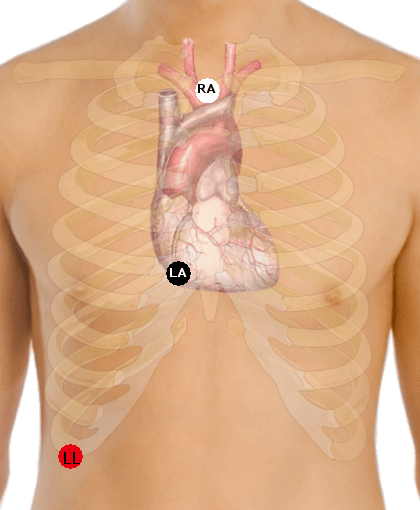
The Lewis lead, named after Sir Thomas Lewis, is an alternate placement that can be used to better view atrial activity in relation to that of the ventricles. In many ECGs, it can be rather difficult to assess P waves; whilst they are represented using standard lead configuration, they are much less apparent than ventricular activity, due to the nature of the ECG’s detection mechanisms.

Using the Lewis lead configuration, it is possible to increase the detection of atrial activity and diminish that of the ventricles and gain a clearer picture of atrial fibrillation, flutter and, in the case of the article that brought my attention to this system, improving P wave recognition in wide QRS complex tachycardia.

The configuration is as follows:

Lewis Lead

  • RA electrode on the manubrium
  • LA electrode on the 5th IC space, right sternal border
  • LL on the right lower coastal margin
  • RL remains in the standard SCST position
  • Adjust calibration to 20mm/mV

As shown on the diagram, a three lead configuration is still present, as in Einthoven’s triangle, but Lead I now travels directly over atrial activity. For this reason, Lead I is used as the monitor lead and the one from which a rhythm strip should be taken.

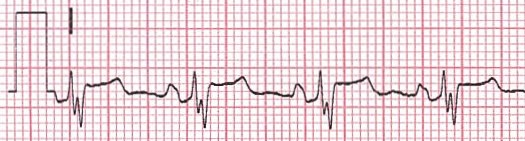
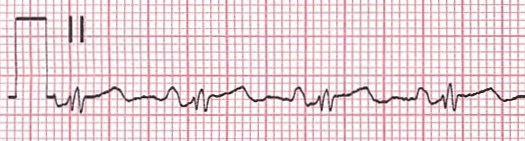
On the trace itself, there is a marked visual difference. The following were recorder on the same patient and we begin with the standard electrode configuration:

normal-lead-I-II

And now introducing the Lewis lead setup:

s5-atrial-lead-i

s5-atrial-leads-iiThe P waves present in these altered leads are much more pronounced.

There are more lead systems that are used in the diagnosis a variety of different conditions such as Brugada syndrome. I’ll research and cover these and try to get some more traces using the Lewis lead system throughout the year.

Traces courtesy of ekgcasestudies.com

Screenshot (39)

How Is Your ECG Electrode Placement?

As a student cardiac physiologist it has been drilled into our heads from an early stage the importance of correct anatomical electrode placement in obtaining an accurate ECG recording. An ECG measures the electrical activity of a patient’s heart from many different angles, and is achieved by placing 10 sticky electrodes on the patient; four on the limbs and six on the chest. For correct electrode placement we follow the clinical body guidelines set out by the our governing body, the SCST. As specialists within the field, we have a duty to perform these tests in a standardised, methodical manner to produce reliable and accurate diagnostic information, as the ECG is the first port of call when assessing heart abnormality.

Screenshot (17)

Unfortunately, from my experience, and from that of my colleagues, the misplacement of these electrodes has become somewhat commonplace. To the unassuming operator this may seem superficial but incorrect placement of electrodes can alter the ECG patterns displayed simulating or concealing abnormalities, such as myocardial ischemia/infarction.

There is evidence that many health professionals who record ECG’s have not been suitably trained or assessed in the technique: A study by Kings College London into electrode misplacement highlighted that only 50% of nurses and less than 20% of cardiologists correctly place leads V1 and V2 during a standard 12-lead ECG. These numbers are quite shocking and highlight the widespread misunderstanding of this key diagnostic tool.

Close0up
An example of how NOT to perform an ECG. V1 and 2 are incorrectly placed, as are 3 and 5.

I personally witnessed an example of this whilst on my first week of placement. I was performing an ECG on a patient within the cardiac ward under the supervision of an assistant technical officer who regularly performs ECGs. I correctly located the anatomical landmarks on the patient’s chest and applied the electrodes, as per the official guidelines. At this point, the ATO interrupted me and challenged the placement of my V1+V2 electrodes, stating they were too low. She then took over control of the procedure and removed the electrodes. She began to count the intercostal spaces, beginning from the clavicle. The guidelines state the operator should identify the manubriosternal joint, or angle of Louis, on the patient to locate the second intercostal space as their first anatomical landmark. This subsequently meant her V1 and V2 electrodes were placed too high and  my original placement was in fact correct. After the procedure I challenged my colleague about this explaining we were taught to follow the SCST guidelines in our electrode placement. The ATO responded by saying that this was “how they had always done it.” I discussed this with my clinical educator and the issue was later addressed with my colleague.

The consequence of incorrect ECG recording can lead to potentially incorrect diagnoses and inappropriate treatment leading to wasteful use of healthcare resources and even cause harm to patients. Evidence suggests that adequate training of operators reduces ECG recording errors. However as the SCST highlights in their guidelines, the indications there is little awareness in many practitioners of the need for training.

Clearly, the solution to this issue is to increase awareness in health professionals exposed to ECG practice about the importance of correct electrode placement.  This could be achieved by increased collaboration between cardiac physiologists and other healthcare professionals. As specialists within the field we have duty to share our expertise and knowledge to ensure our patients receive the best standard of care. As a profession we should be much more active in teaching and increasing awareness of what we do and why it is so important. Relevant staff should be confident in performing ECGs not because of experience, but due to high quality training and continual auditing.

To achieve this I feel our profession needs to embrace this responsibility and be far more active in the support and training of other health professionals.

Khunti, K. (2013) Accurate interpretation of the 12-lead ECG electrode placement: A systematic review. Health education journal . 73 (5) pp. 610-623.

Harrigan, H., Chan, TC., Brady, JW. (2012) Electrocardiographic Electrode Misplacement, Misconnection, and Artifact. The Journal of Emergency Medicine [online]. 43 (6), pp. 1038–1044.

Baxter, S, Blackman, S, Breen, C, Brown, C, Campbell, B, Cox, C, Eldridge, J, Hutchinso, J, Rees, E, Richley, D, Ross, C. Society for Cardiological Science and Technology (2014) Recording a standard 12-lead electrocardiogram. Available from: http://www.scst.org.uk/resources/CAC_SCST_Recording_a_12-lead_ECG_final_version_2014_CS2v2.0.pdf

http://millhillavecommand.blogspot.co.uk/2012_05_01_archive.html

Screenshot (39)