The Art of Anatomy

Remember those  anatomy and physiology lectures that tortured you? Remember all that terminology that was relentlessly thrown at you for  hours every week? Remember the pop-quizzes? Remember wishing there was an easier way to store all the information you were given?

Of course you do.

A few institutions have employed a rather novel way of encouraging learning by doing, by combining art and anatomical learning. Cathal Breen of Analyse fame kindly sent me a copy of the University of Ulster’s journal outlining a study he was a part of, that brought the two disciplines together.

The study focuses on exactly what I outlined in the first paragraph: the difficulty in learning anatomical names and information via textbooks and lectures alone. Students from radiology and cardiac physiology formed groups and learned by painting anatomical structures on each other, using textbooks, presentations and spoken word.

By encouraging students and staff to engage in the teaching and learning process in this creative manner yielded incredibly positive results: student feedback referred to the sessions as “enjoyable”, “helpful” and “interesting”, citing the experience as one that makes things clearer, too. The study humorously points out that the first three statements are not things that have been used to describe A&P before (thanks to my own experience, I imagine this to be an indisputable fact).

Obviously, there may be issues with inhibition when it comes to each individual, so to get around this, painting onto clothing; t shirts, gloves etc, is an option. Lecturer participation is a must, so the whole thing seems to lend itself to full participation from everyone and bonding in a shared learning experience.

Students pointed out that this style of learning made them aware of discrepancies between actual anatomy and the pictures contained within the textbooks they used, and that gave them a better understanding of the internal geography present in the body. In recent years, the practice has been adopted by numerous institutions, and the twitter page @artandanatomy showcases some of the wonderful body-painted works of art that have cropped up across the globe.

So, what do you think? Would this be something you feel would make the learning process easier for you? Sound off in the comments below and let us know.

Ref:

Breen, C., Conway, S., Fleming, K.,. (2010) The Art of Teaching Anatomy – A Case Study. Perspectives on Pedagogy and Practice 1 (1), pp. 17-30.

Images courtesy of @artandanatomy 

Screenshot (39)


ECG Difficulties

I never considered just how difficult trace analysis could be. Don’t get me wrong; I knew it would be hard, I just didn’t fully appreciate quite how hard.

During lectures on specific arrhythmias, when ECGs are displayed, they generally contain the abnormalities that make up the subject matter so it doesn’t take long to come to the correct answer, but looking at a trace without any history or prompting as to the condition, is still overwhelming to me. So overwhelming, in fact, that I often feel like I’m falling short of the mark with regards to my learning as a whole. The TSP ECG section is as much for my benefit as it is for you guys, in that I’ve found analysing the ones selected for posting incredibly difficult.
No matter what answer I come to, there’s always the lingering worry that I’ve missed something.

How much is too much, with regards to analysing?

What’s a result of over-analyzing, and what’s accurate?

Textbook traces, whether clinical, or stylised, have been selected as the best possible example of the rhythms under scrutiny, so it stands to reason that they won’t exactly mimic those that will be encounered in the field. In my limited experience, clinical traces contain a great deal of variation and have thus far, rarely resembled anything you’d find in a book.

They have been difficult, yes, but they have also been possible. This will all become easier, with practice (I assume/hope), so I hope you all find the analysis quiz good practice, as it’s certainly proving to be that for me.


Screenshot (124)

Is Mobile Echocardiography On The Horizon?

Smartphone and tablet technology is advancing at a rapid rate, so it should come as no surprise that it is being used for a variety of different purposes. Healthcare companies are finding novel ways to encourage patients to take charge of their own health; peripherals allow for BP measurement and three lead ECG monitoring in one’s own home, and it’s possible to measure your heart rate at rest and during exercise now, with software that comes as a pre-installed fitness suite on most modern devices.

It stands to reason, then, that these same companies would create clinical grade applications and device extensions that would benefit practitioners, also. I covered the use of Google Glass in revascularisation, already, but another device is making its way to the market at the moment, too; mobile ultrasound.

After unveiling it in 2014, Philips were granted FDA approval of their Luimfy system only a couple of weeks ago and have announced that it is now available for purchase in the US.

A $199 per month subscription, an Android phone/tablet and a micro USB probe are all you need, as the app and it’s peripheral are designed to work with compatible devices off-the-shelf.

In its current form, the scanning app allows practitioners to examine the gall bladder, abdomen and lungs, in addition to having obstetric, vascular, superficial, musculoskeletal and soft tissue functionality, so the device isn’t suitable for echocardiography, but I’m certain that in the future, given the power already available in modern devices, it’s a real possibility.

In UK hospitals, where space is a deciding factor for treatment options, having an ultrasound monitor that can fit in a small case would be a real boon. Emergency and critical care ultrasound is actually what the system was designed for, so it makes sense that the most obvious impact relates to time and accessibility.

Streamlining the healthcare process is paramount, and the fact that this system is based around an app could be a real advantage. The images gained by the practitioner can be shared via the cloud, so the network of professionals involved with one patient can have near instant access to the relevant materials needed for diagnosis. Philips could also provide continued software support and provide updates based on user feedback, without the need for engineer call outs.

Now, I’m no app developer (I’m trying. It’s rather complex…), but I do use them, so I can identify some common problems in cloud storage and functionality.

Firstly, as this is an Android app, it may present issues in performance across devices. There are a number of latency issues with apps for this OS and further issues regarding app performance in general from one device to another, especially if the base OS differs slightly between manufacturers (if you’ve tried to compare performance between Samsung and Google Nexus, you’ll know what I mean). In this case, Philips would have to be fairly on the ball with their customer support, especially given the subscription costs for practitioners.

I guess the issue with cloud storage brings us to patient confidentiality, as the last couple of years have seen some high profile cloud hacks leak “sensitive” data to the public, but many hospitals are already digital, so surely it’s a case of ensuring the level of security is appropriate.

As far as echo goes, the advantage of switchable probes and live, cloud updating comes into its own; echo features could be added with an update, in theory. It’s a case of making it happen. It’s unlikely, but if I ever get a chance to try one, I’ll make sure to tell you of my experience.

For more information, go here: http://www.ifa.philips.com/news/digital-innovations/philips-lumify

Screenshot (39)

SCST National Update

Yesterday, on the 20th of November, Oli and I attended the SCST annual update meeting. It’s the first physiology conference I’ve attended that wasn’t tied to one specific trust (the last one I attended was the Royal United Hospital’s respiratory medicine conference), rather, it was applicable to and attended by cardiac scientists from across the four home nations. The day was packed with talks, networking opportunities and insight into the future of the science. Speakers hailed from a variety of professions and organisations, but all were entrenched in the science of cardiology and education.

Due to the long distance travel and Birmingham’s seemingly city-wide roadworks, Oli and I missed the introduction, but we were present for the rest of the day and we recorded and annotated everything else, so whilst I’ll provide an overview here, detailed breakdowns of everything relevant to PTP study will be supplied separately, as and when time and my coursework volume allows.

Of particular note is the information on preceptorship qualification, delivered by Sophie Blackman of SCST and Boston Scientific. I collared her after the event proper, and she kindly agreed to provide the literature pertaining to this, so as soon as it’s available, I’ll add it for you all to have a mosey over. It seems like a great opportunity for newly- qualified practitioners to become super confident in all aspects of their job, so I highly recommend that you read the contents when they’re available.

Dr Patricia Oakley of King’s College outlined the plans for a new variety of health clinic: the centre that isn’t home and isn’t a hospital, but the “place in the middle”. These will be networked, multidisciplinary centres, featuring social workers, scientists, psychiatrists, GP’s, etc, so cardiac physiologists will most likely be a necessity in their implementation. The whole session really drove home the emerging importance of this profession, but also the requirement of all of us, student and qualified, to ensure that the cardiac physiologist is recognised as being at the forefront of innovation so as not to be overlooked. It was mentioned more than once, that if we don’t put ourselves forward for emerging structures, someone else will.

Dr Oakley told of the need to reduce treatment variability by region. Her example was the treatment of amputation as a result of diabetes; Devon has, by far, the highest number of below-hip amputations when compared with the rest of the UK, due to the fact that the majority of Devonian surgeons trained under a surgeon who has a penchant for this level of removal. The advent of these networked clinics will reduce this level of variability and promote consistency across the home nations.

The president of the AHCS, Dr Brendan Cooper delivered the final talk of the day, discussing the future role of the healthcare scientist in wider healthcare and medicine, and the need for physiologist prescribing. I’ll provide  a detailed breakdown of this talk next, and shall hopefully post it in this coming week.


Screenshot (39)


Interview With A Distance Learner

The fact that this specialist degree exists primarily in universities is a relatively new event; before the shakeup by Modernising Scientific Careers, the majority of training was completed in-house with an element of distance learning thrown in to assist with the theory behind the practical concepts.

As physiological science makes the transition to a 100% university- led discipline, there remain students that are still learning the “old way”. Sarah is one of those people, and I had the pleasure of working with her this year during my rotations between respiratory medicine and cardiology. In order to get a bit of insight into exactly how the course differs between bases, she kindly agreed to be interviewed for TSP.

Hux-Ham

Hello Sarah! Could you outline the structure of your week, with regards to working in your department and studying the degree simultaneously?

I’m employed by the hospital, so have to work my set hours which are Monday – Friday 08.30-16.30. Although I’m studying, I am not employed as a student, rather, I am an Assistant Technical Officer, which basically means I help around the department doing admin, portering and some clinical work. I have certain responsibilities with regards to admin that I have to keep on top of regardless of what clinical work I need to be learning.

Monday is my main admin day, so I spend the entire day sorting through referrals, checking messages & booking appointments for certain procedures that only I book. I need to keep on top of this as some of the procedures have extremely long waiting lists, so if a patient cancels last minute I need to try my best to fill that slot. Once my admin is complete I normally help out my colleague in the office with some of her work load. If there is no porter to bring inpatients up & back for echocardiograms then it is part of my job to do this as well, which means I can’t get my necessary admin work completed.

Tuesday is the start of my clinical week, unless I have been portering the previous day. At the moment I am spending all day Tuesday in analysis, analysing 24 hour and 48 hour tapes. I am able to analyse a tape independently, but as I am still learning they all need to be checked after, just in case I’ve missed something or worded my report incorrectly.

Wednesday is a half day in the department for me as I have a collaborate session starting at 12.00 so I need to be set up in the library ready to start. After my collaborate session I catch up on any studying I need to do, such as looking over lectures that have been released for the following week, researching/ writing an assignment or revising for upcoming exams. On a Wednesday morning I will either be fitting ambulatory blood pressure monitors (supervised, as I am not confident to do them alone yet) or analysing.

Thursday mornings I am in Electrocardiography, either in the department or going down to the ward, and in the afternoon I analyse.

Friday mornings I do tape clinic which occupies the entire morning and keeps me very busy, especially if I have patients returning that have had symptoms of dizziness & I need to get the tapes checked before I can let them go. I spend Friday afternoons in analysis.

That is my current working week, but I will start going on the rota soon to sit in on exercise treadmill tests as well. Most mornings I get into work at around 07.30 so I can get some studying done before work and I try to do an hour or so in the evening as well. Most weekends I keep to myself, but if I have an assignment due or exams I will do a couple of hours each day.

That’s a hectic week. This might now be a silly question, but do you feel that this is this enough?

In terms of clinical exposure … yes! But it is very hard to keep up with the academic work load when there is very little time to fit things in. I commute for over 2 hours a day so this eats into my potential study time, but I try to keep a balance of work, study and actually having a life!

Do you feel that working in the same department as you study helps you to learn more and keep you motivated?

I feel that second year especially has helped me learn, but most of the academic work in our first year wasn’t particularly relevant to cardiology. I feel like I learnt more in the last 2 months from analysing tapes than I have in the whole 2 years that I’ve worked in the department. I definitely think it has helped to keep me motivated as I’m constantly surrounded by people that are doing the job I am training for, so I’ve got a clear goal at the end of it.

You’re one of the last sets of the distance intake. Do you think, if you had the choice, you’d still do the degree in the manner you currently are, or would you choose to be based at the university?

I’ve already done a previous degree so I’ve experienced the whole student life thing, so I’m not missing out by doing it this way. At the moment I am essentially being paid to learn, which is ideal. I wouldn’t be able to afford to do this degree if I was based at the university, as I’ve already had a student loan so I’m not entitled to another. I think I get a good amount of exposure in the clinical setting, but I just have to do some of the boring admin jobs to make up for it. At the end of my degree I will have a job and I know 100% that this is the career I want for myself. I wasn’t passionate about my previous degree subject so I lost interest and didn’t want to spend the rest of my life doing it, whereas I know from working in this department and from studying the way I am, that this is what I want to do. I don’t think I’d have that level of clarity if I was based more at the university than the hospital.

That’s fair. When we worked together during my placement, I was aware of the fact that you were much more comfortable in the clinic environment than I was (obviously), so what do you feel we at the university have by way of an advantage?

I definitely think that as I’m exposed to patients and the environment all day every day that I am more confident and comfortable than yourself, but I would say that full time students based at the university have a lot more academic knowledge. We have 1/2 hours a week of contact time with our lecturers so we need to go out and research ourselves, whereas it is clear that you guys have a lot more academic time although you miss out a lot with the lack of placement.

Thanks, Sarah!

As you can probably tell, despite the fact that Sarah and myself are in the same cohort, our academic years have a vastly different focus. As I (rightly) assumed just from working with her on the department, both routes present their pros and cons, and seeing as this is a vastly understaffed form of diagnostic science, it does, in my opinion, open the career up to a greater number of people now it will be university- led.

If you’ve got an opinion, or a question regarding anything you’ve read, sound off in the comments below.

Photo courtesy of Facebook

Screenshot (39)

The Lewis Lead

Scouring the web for cheap textbooks, I happened upon something of which I wasn’t even remotely aware: alternate ECG lead placements. As has been highlighted in previous posts by myself and others, cardiac scientists have strict guidelines that ensure we perform an ECG procedure to an accurate and repeatable standard, so it came as a bit of a surprise to discover that there existed a different way of carrying out the test with an aim to view specific activity.

The Lewis lead, named after Sir Thomas Lewis, is an alternate placement that can be used to better view atrial activity in relation to that of the ventricles. In many ECGs, it can be rather difficult to assess P waves; whilst they are represented using standard lead configuration, they are much less apparent than ventricular activity, due to the nature of the ECG’s detection mechanisms.

Using the Lewis lead configuration, it is possible to increase the detection of atrial activity and diminish that of the ventricles and gain a clearer picture of atrial fibrillation, flutter and, in the case of the article that brought my attention to this system, improving P wave recognition in wide QRS complex tachycardia.

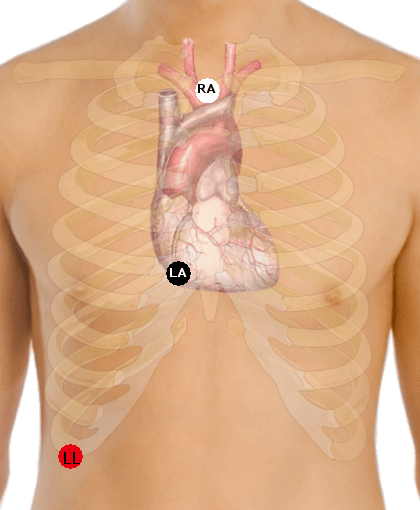
The configuration is as follows:

Lewis Lead

  • RA electrode on the manubrium
  • LA electrode on the 5th IC space, right sternal border
  • LL on the right lower coastal margin
  • RL remains in the standard SCST position
  • Adjust calibration to 20mm/mV

As shown on the diagram, a three lead configuration is still present, as in Einthoven’s triangle, but Lead I now travels directly over atrial activity. For this reason, Lead I is used as the monitor lead and the one from which a rhythm strip should be taken.

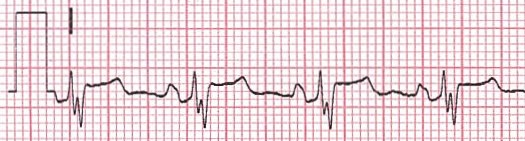
On the trace itself, there is a marked visual difference. The following were recorder on the same patient and we begin with the standard electrode configuration:

normal-lead-I-II

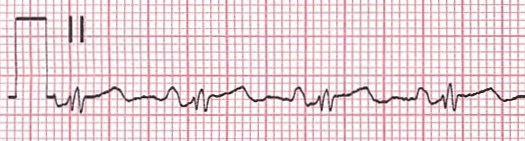
And now introducing the Lewis lead setup:

s5-atrial-lead-i

s5-atrial-leads-iiThe P waves present in these altered leads are much more pronounced.

There are more lead systems that are used in the diagnosis a variety of different conditions such as Brugada syndrome. I’ll research and cover these and try to get some more traces using the Lewis lead system throughout the year.

Traces courtesy of ekgcasestudies.com

Screenshot (39)

Have You Ever Tested A Robot? Pt II

I still haven’t.

Bear with me, though, as this is going somewhere, I swear.

After the last session, in which I provided the robot’s voice and controlled its HR and ECG, it dawned on me that as a result, everyone had the opportunity to be filmed performing the test and gain valuable group feedback, except me.

I wasn’t the only one to notice this, as it transpired.

During a subsequent lab session, wherein we practiced manual BP, honed bedside manner, discussed contraindications and compared different methods of BP measurement, it was revealed that the remainder of our ECG feedback period would be completed in the lab. We no longer had immediate access to the simulation mannequin, so thanks to a willing volunteer, another of my colleagues was able to complete the procedure and again receive feedback in a partitioned area of the lab.

Then it was my turn to step up to the plate.

I was the last to ‘go’, as it were. The difference between my assessment and the other’s lies in that everyone else enjoyed an element of seclusion: the curtains around the bed-space being pulled in the first session and the high walls that separated one section of the lab from the other, in the second. The rest of the group stayed outside of these boundaries in everyone else’s case. Not for me, though. I stood away from the couch, preparing to make my entrance to the imaginary treatment room I could see in front of me and just before I could open the invisible door, the consultant physiologist taking the session said “Wait, I’m just going to call everyone else in, if that’s ok?”

“…If that’s ok”, as if I had a choice.

Everyone else filed in. They kept filing in for what felt like an age. My lecturer, the rest of my class and the head of physiology. Then, they all looked at me, waiting.

I’m not sure how I’d have fared if I’d known this was going to be the format for my peer assessment, but I feel no shame in admitting that I don’t remember ever being as scared as I was before I started moving. I didn’t know how to begin, so I just went for it. I walked into the ‘room’ (after, somewhat embarrassingly, opening the invisible door) and performed the test as I would out on placement.

I asked all the required questions and added one or two patient identifiers to account for the fact that I didn’t call my patient from any waiting room and gained a consented, accurate trace.

Not only did I do it all with the eyes of more than a couple of people scrutinising my every move, I did it with a piece of equipment I have never used before and the most tentacle-like cable configuration I’ve ever seen in my life- if you’ve tried to untangle the wires behind your television when you’re moving house, you’ll know what I mean but, trust me, this was worse. In addition, I managed to ignore a completely new experience: the fact that I was so scared that the back of my neck was sweating..!

Fear is natural. It’s normal to be scared of doing something that’s relatively new to you, especially when you know you’ll be watched and judged doing it. Whatever ‘it’ is, it wouldn’t feel like a real achievement if we didn’t feel fear beforehand. I’m glad it was sprung on me, if I’m honest. My final assessments and various practical examinations for the rest of my career will follow this format so it’s good to have a grasp on some of the emotions I’ll be feeling before them. If you’re just beginning the PTP programme, you’ve got things like this to look forward to, so just try to enjoy it. Realise that the fear of these things is normal and, most importantly, the sooner you take a deep breath and swallow the lump in your throat, the sooner they’ll be over!

Thanks!

Screenshot (39)

Hydrogels As An Alternative To Reperfusion And Transplant.

“Cardiac failure is a critical condition that results in life-threatening consequences. Due to a limited number of organ donors, tissue engineering has emerged to generate functional tissue constructs and provide an alternative means to repair and regenerate damaged heart tissues.” 

Such is the sentiment from Ali Khademhosseini and a team from Massachusetts. In fact, they reported here, that in 2009 an average of 77 U.S. citizens underwent transplant each day, but 20 died as a result of a lack of organ availability. The aim, then, in the absence of treatment, is to repair the damaged organ in-situ so as to negate the need for transplant at all.

Enter hydrogels.

Hydrogels are already used in the regeneration of a variety of tissues, and combined with some of the brightest minds in the field significant advances are being made in regenerative medicine: in May this year a team in Toronto have successfully repaired brain tissue after stroke and partially reversed blindness. These versatile substances are also used in disposable nappies, silica gel and contact lenses, so there’s a high chance you’ve already been exposed to them without even knowing it!

These polymers exhibit many desirable characteristics in regenerative medicine. They are relatively easy to synthesise, they can act as solute transports/drug-delivery systems, exhibit elastic properties as well as preventing thrombosis. Their structure also enables them to create a “scaffolding” for cells.

This last point is crucial when combined with the hydrogel’s other properties, but I’ll return to that shortly.

First, consider what happens to cardiac tissue after an acute myocardial infarction: during infarct, the oxygen supply to myocardial cells is reduced or diminished, causing irreversible cell death and necrosis around the occluded artery/arteries. The scar tissue that takes the place of the once-functioning cardiac muscle has none of its contractility and the heart is far less efficient as it once was. Cardiac output, systolic and diastolic functions are affected and whilst medication, reperfusion techniques a bit of luck regarding preserved left ventricle function all provide a better prognosis, heart failure is a serious risk and figures regarding mortality rates aren’t great: MI, specifically STEMI brings with it a 30% mortality rate, 50% of this figure dying before hospital admittance and 10-15% being re-hospitalised one year after the index event.

So, where do hydrogels come into the picture?

In the case of extreme loss of cardiac function and the inability of conventional treatment to improve the given prognosis, hydrogels provide an environment in which it is possible to introduce stem cells, growth factor, gene injection or therapeutic medication in an ‘artificial’ environment that simultaneously provides mechanical support to the infarcted area and aids in the replacement of necrotic tissue. As well as being a relatively non-invasive procedure when it comes to the injection of the treatment, the hydrogels scaffold itself is naturally degraded by the body when the process is complete.

According to another team in Massachusetts, published here, trials have shown significant success since they began in small animals, but their application isn’t as straightforward in large primates. They commenced in humans in 2008 (in an extremely truncated form), but in order for hydrogels to be viable in widespread clinical treatment, much more research is required. An example of this is that not much is known about the exchange of signals that take part in the movement of stem cells to an injured myocardial tissue post-hydrogel treatment. Optimum degradation time is a further issue in humans.

Despite these, and other setbacks, there remains great promise in hydrogels to lower global mortality rates as a result of MI. In recent years, significant advances in research are making the possibility of myocardial repair in humans an almost visible reality.

Thanks!

Screenshot (39)

Light At The End Of The Tunnel

Having being around for a few years now, I’ve read an ECG or two in my time.  If you’re still early on the road to becoming a fully-fledged Physiologist though, let me assure you of one thing:  IT DOES GET EASIER!

I won’t lie, even with the experience I now have, there are still the occasional strips that leave me scratching my head like a confused monkey but on the whole, a 12-lead doesn’t scare me anymore.  One thing that I think many students will find at some point during their learning, is that their more experienced counterparts have somehow forgotten how difficult it is to read an ECG. You might take an ECG for someone to check and receive a reply along the lines of ‘Well, obviously this is…’ Not all that helpful!

Learning to read an ECG is a lot like learning to read a new language. Sure, if you’ve been practicing for a long time, you’re pretty fluent, but it’s important to remember how hard you found it back when it was still just a foreign language to you. Only then can you start to empathise with those who are in that position now. And if you are in that position now, don’t give up!

If I could offer one word of advice to you, the person reading this who is desperately trying to get to grips with ECG, it would be this: get to know what a normal ECG looks like really, really, REALLY well. Then, get to know how that relates to the electrical and mechanical activity of the heart. (I suppose that’s sort of 2 pieces of advice but stick with me here). If you can get all of that into your head, you’re putting yourself the best possible position for progression.  If you instantly know what a normal ECG looks like, any abnormality should stand out like a sore thumb. You might not know what the abnormality is, but if you know how the ECG waveforms relate to the mechanical activity of the heart, you can at very least a take good, educated guess on what that abnormality suggests the heart is actually doing. You won’t be an expert, not at first, but you will have the foundations on which you can build and make yourself one.

Therefore, the most important first step is to learn what is ‘normal’ but I’ll discuss that in detail in a later post.